 Thinking about the power of water is pretty abstract. Even looking at a place like the Grand Canyon it’s hard to grasp that innocent drops of water carried away its entire inside.
The Drake Passage is one of those interesting places in the world where water matters quite a lot. If you look at the globe, you see Antarctica on the bottom, and surrounding it is water, the Antarctic Ocean. This ocean is pretty much made up of the southern parts of the Pacific Ocean on one side (between Australia and Hawaii) and the Atlantic Ocean (between Argentina and South Africa) and on the other.
This Antarctic Ocean rolls around above Antarctica unobstructed as the Earth spins, sometimes subjected to massive wind storms that shake up this water, sometimes into giant rolling waves 100 feet from trough to peak.
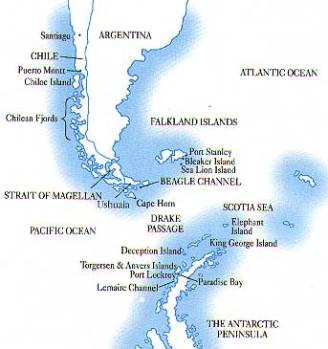
But there is a problem. The bottom tip of South America, Cape Horn, sticks out south towards another tip of Antarctica that reaches north.
(Something about them being attached millions of years ago as part of that big landmass I can never remember the name of from before the dinosaur times.)
The Atlantic Ocean is warmer than the Pacific Ocean, and both of them have their own flowing currents, not in the same direction, and when they mix down between Cape Horn and the Antarctic Peninsula it’s not exactly predictable.
So, all those giant waves roll around the Earth until they hit this narrow gap, and as they still need to keep rolling around, even though the channel between the two points of land narrows, the speed of the water passing through this channel has to speed up. And it becomes turbulent, and if you add some unruly winds, wildness results. Rogue waves are the kind of waves ships don’t like to meet sailing down a dark canal at night, you know, like the one that took out the cruise ship, the Poseidon, in that adventure movie about the people who had to climb through an upside down ship.
I can’t help think about the man the channel is named for, Sir Frances Drake (1540-1596), the first captain to get credit for surviving the trip. How those people in all those wooden sail ships survived in places like this is something I can’t wrap my understanding around. In freezing weather climbing 80 foot masts in bare feet to move thick ropes and sails coated with tons of frozen sea-spray in winds and seas so wild you can barely hold on to your perch… befuddles my imagination.
And that is the Drake Passage.

 icebergmuse.com