
Buenos Aires, Argentina
Our bus tour guide told us Argentina is a country founded by Spain, populated by Italians and trying hard to be French. The guide book explained Buenos Aires, Argentina’s capitol of almost 3 million people, is the Paris of South America. It certainly has an old European flavor, apartments and storefronts are designed to French standards and often by French architects.
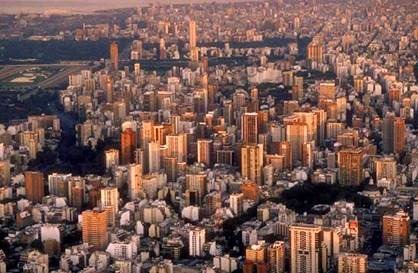
Buenos Aires reminds me of a blend of North America and Europe. 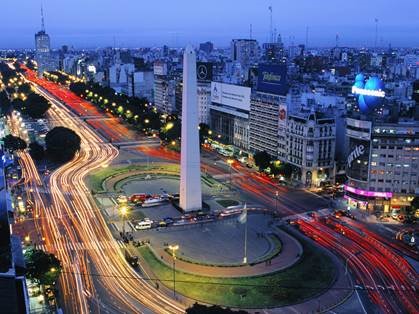
Buenos Aires even has an obelisk commemorating their independence like the one at Concorde Place, Paris.
It’s set in the middle of rich farmland where they grow soybeans and giant steaks. Coming from the Midwest USA I’m spoiled by good beef, but they are just as good at it here, possibly even better.
The streets are laid out the way I am used to from Chicago, a N-S or E-W grid system with a few diagonal afterthoughts. Intersections, however, are pretty unique. The corners of storefronts are cut off so the streets at intersections seem more open, all the corner areas being large triangles of sidewalk instead of shops cornering out and tripping you up. 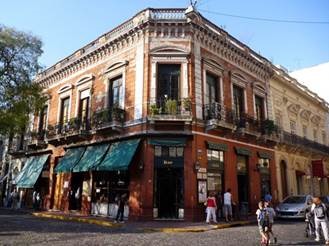
On the way south by plane I sat next to a woman who laughed at my frustration trying to deal with the chaotic seating arrangements. She said: Welcome to Argentina!
Even though I flew with United Airlines and had selected my seats six months earlier and verified my selection earlier in the day, my seat assignment was changed at the gate. Usually that is not a problem, but when another passenger’s seat was also changed, but after they received their boarding pass so two people received the same assignment, chaos ensued. And when the same situation occurred throughout the cabin, at least six others had similar issues, the crew had their hands full.
Eventually the situation was, for better or worse, resolved. My seatmate was a charming blonde woman with the voice of a torch-singer and about sixty-five years old, travelling with her husband. She decided to take me under her wing to educate me on Argentinian politics… which seemed to be responsible for the situation that caused my seating problem…
I’m not reproducing the entire conversation here, but Argentinian history and politics is an extremely interesting subject and worth investigating.
It’s not more than forty years since about 38,000 people were kidnapped by the state, held at Argentinian police houses then tortured, drugged and dropped out of the back of military planes or helicopters into the deep South Atlantic ocean. The photo below is a memorial at the location where one of the police houses used to stand.

Sting even wrote a song about the mothers of the “disappeared”: They dance alone. Worth listening to. Mr. Pinochet, Argentina’s dictator, to distract from all their failed policies and Argentina’s unhappy situation then invaded The Falkland islands. Margaret Thatcher, the Prime Minister of the UK, to whom the Falklands belonged, said no, and sent people to kick Argentina off the sheep filled sparsely populated treeless islands. Even the US supported the UK with a Naval blockade.
You may wonder why all this seems important to me today. And I will explain. My trip to the oldest café in Buenos Aires, Café Tortoni, was made quite noisy by politics. The Café, founded in 1858, has charm and beauty and great alcohol laced coffees.
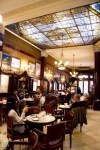
However, outside it, the city boiled with labor unions parading the streets with banners, flags, drums, and firecrackers. Outside Café Tortoni the teacher’s union and another education related union had a battle of speeches and zealous chants.


Apparently, the new president sworn in two months ago, well liked as far as I can tell, is battling corruption by firing all the workers who only show up once every two weeks to collect their checks, irrationally expecting workers to show up on every work-day even when they aren’t handing out paychecks.
I have to admit, I could never figure out what they were protesting. If they protested the firing of the employees who didn’t work for their salary, or the government that permitted that kind of corruption, or both.
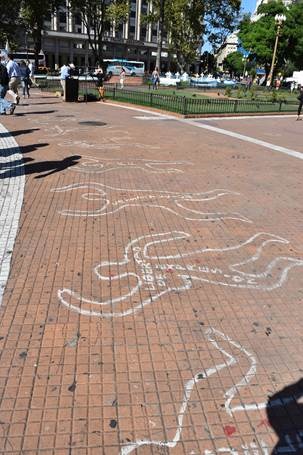
At the memorial square, Plaza de Mayo, where Argentinian independence from Spain is celebrated, the entire open area is ringed by drawings on the walkways. The drawings are painted outlines of bodies, like chalk marks drawn by police at murder scenes. Inside each outline, in Spanish of course, was written a word in paint, a word that named each “body” with the good things done by the government, such as, “education”, “unions”, “healthcare”. And trying to discover why outlines of bodies (that by some coincidence all had red paint spattered inside them like marks of blood), all had “good” things the government had done written inside them, defeated my powers of deduction.
We also visited the six acre Recoleta Cemetery, a place of great beauty.
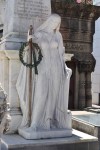
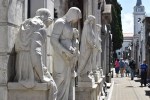

All mausoleums are personally owned like some of the old cemeteries in France. It’s where Evita Duarte Peron is interred.
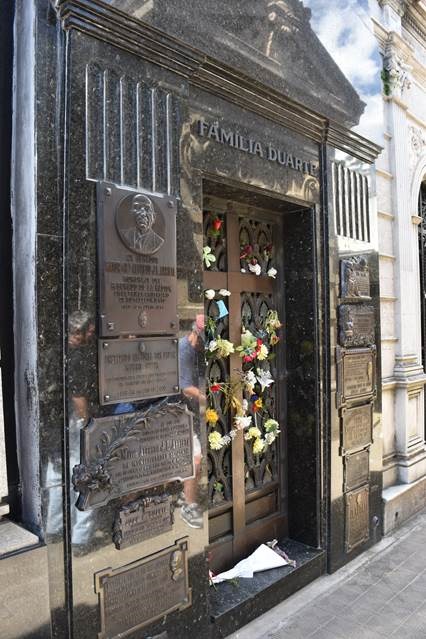
Evita, a girl born in poverty, a singer who married a man who became leader of Argentina after WWII, died at age 33 from cancer. She is known for style and charisma and stealing massive amounts of money from the Argentinian people. But the people of Argentina still adore her, in part for founding unions and helping workers gain rights.
On our way walking home past the Liberation Plaza we ran into the President of France laying a memorial wreath at Plaza de Maio, the Independence statue, you know, the one of Guido de San Martin, the guy who liberated them from Spain, using the French liberation as their blueprint.
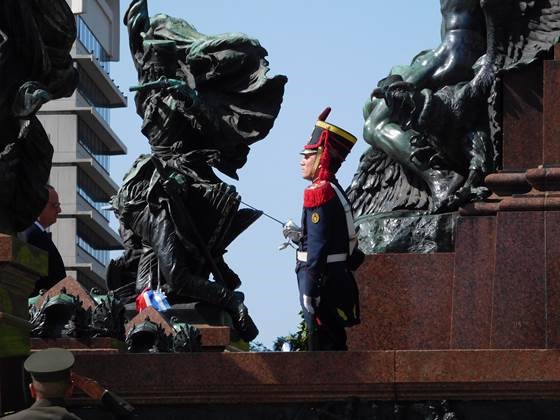
President of France, cool. Keep running into him.
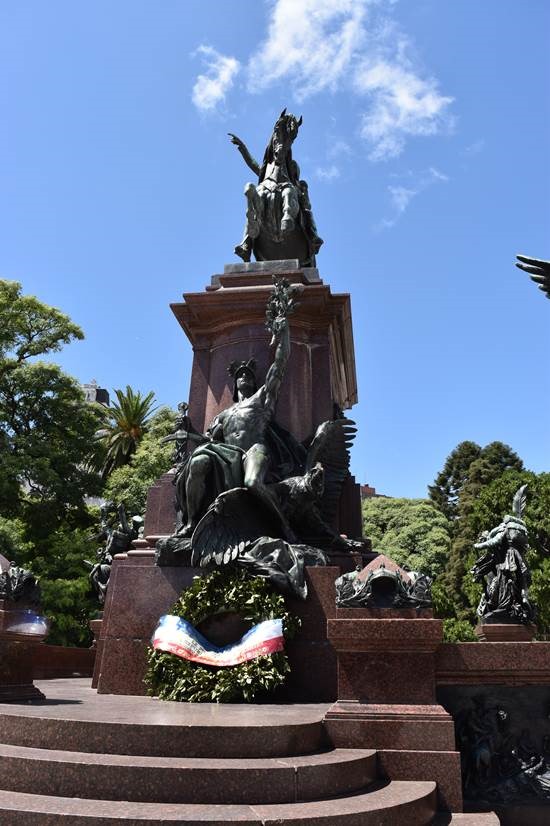
This country is a conundrum of inconsistencies and in more ways than one is a breath of fresh air.
Buenos Aires.
 icebergmuse.com
Loved this post! The information, the writing, and the pictures! One of my ancestors is buried at La Recoleta!
LikeLike