Boarding Day

Oct 29, 2017

Montevideo, Uruguay

This post is basically a boring summary of where I am going and how my journey is both the same and different from the last one, about twenty months ago. Since arriving in Montevideo, Uruguay two days ago I can’t say I’ve engaged much with the city. For some reason it hasn’t captured my imagination either politically or historically, unlike how Buenos Aires spun stories in my mind the last time I was here. I’ve pondered why I don’t run around photographing every interesting building or walk along the extensive shore; the city juts out into the Rio de la Plata, basically a bay where the Plata, a great South American river forms a giant estuary and meets the Atlantic Ocean. Buenos Aires and Montevideo sit across this estuary from each other, 130 miles by air, but politically they are worlds apart. More about this in another post.

This is the logical jumping off point for ships sailing to Antarctica; at least the ship’s first journey of the season. They come south for the southern summer from where they have spent the last six months cruising the northern summer in Europe or Greenland. There are at least four major cruise ships in the neighborhood right now waiting to take on their Philippine crews and international passengers. Hotels are packed with Antarctic traffic. This all used to take place in Buenos Aires, just across the way, but now must take place in Montevideo, rather, not in Argentina.

Argentina will not allow ships that travel to any British port, such as the Falklands, or Port Lockeroy in Antarctica, to dock in Argentina. It hearkens back to the Falklands dispute, and is a way Argentina keeps their people looking out to a common enemy rather than inside at their own political leadership. (Sound familiar?)

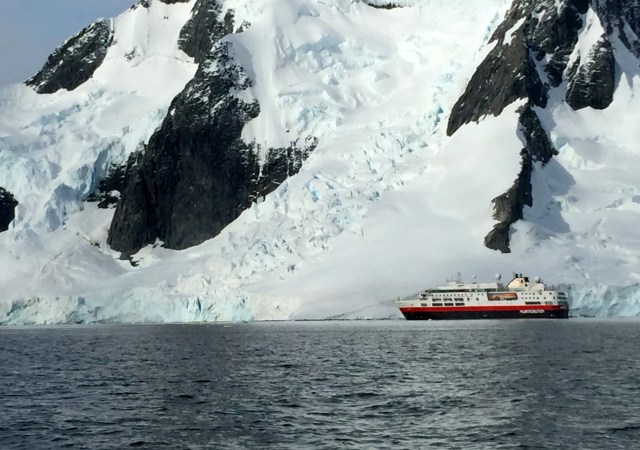
This is my second sailing with the MS Fram on the nearly identical three week journey and I pretty much know what to expect. Although, this time the journey will sail to the three main locations in reverse order.

Last time Mike and I arrived in Buenos Aires, Argentina in February, their fall. This time we start out in late October, their spring. This time we expect cooler weather, maybe a little more snow, maybe a few more penguin babies, maybe a few less whales. Although we saw virtually no whales last time so that can only improve.

Last time, we spent a few days sightseeing Buenos Aires and its old and complicated history. Then we flew with the rest of the passengers to Ushuaia, Argentina, a booming little tourist and cruise destination just north of Cape Horn, the southern tip of South America. The land there is called Patagonia, and Tierra del Fuego; both names well known to explorers dreaming of remote locations. Then, we boarded MS Fram for the first time, to sail south for the Antarctic Peninsula, then to South Georgia and the Falklands, and eventually back to Buenos Aires.

This trip will begin in Montevideo, Uruguay, sail for the Falklands, South Georgia, then the Antarctic Peninsula and end us up through the Drake Passage to Ushuaia, Argentina. For some illogical reason ships are allowed access to Argentina only through the port of Ushauala. This probably has something to do with safety at sea and finances. The passengers will then fly to Buenos Aires and spend the night. The next morning I am going home.

Mike and I talked about this last night, the trip last time was such an intense experience we both feel as if, in some ways, we’re coming home to the Fram. It became our home last time as we bonded soundly with a group of passengers and with our expedition team, who, when out in the wild always wore their red jackets.  When we left the ship that final time each team member of the expedition team wore their familiar red jackets and positioned themselves along our exit route, as they always did on every landing. As we as we collected our bags and found our final transportation back to our old lives we said goodbye to each of them and quite a few tears fell as they guided us through this elaborate final farewell. The ship and the team had become such an intense part of all our experience, it was the limit of our world, our safety, our entertainment, our guides and the source of our education about a part of the world we had known in our imaginations and now finally experienced personally.

I am here not to explore this city but to move along to something else. This is all on my mind as I wait impatiently to leave Montevideo.



Antarctica- An Essay

Antarctica
by A. C. Andersen

​I love a dead man I’ve never met. Although, in my mind, he’s not dead. He’s here just outside, maybe sleeping in his canvas tent, or maybe he’s looking after the dogs. He was here only a hundred years ago but seems so near. I need him to help me understand.
The wind made a snare-drum of the fly. The Antarctic gale whipped so hard against the side of the tent it blasted straight through my ear plugs and roused me from sound sleep. So much for the silence of the Antarctic.
My tent mate, Anne, slept on. She, like Robert Falcon Scott, was from England. I, like Roald Amundsen, from Norway. We were destined to travel together.
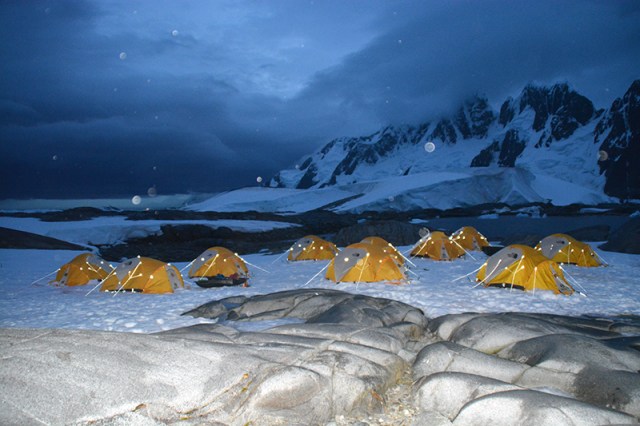
​Eighteen of us from the cruise ship M. S. Fram set up a tiny tent city on Hovgard Island. It’s a rock of an island about the size of a football field along the outer coast of the Antarctic Peninsula; that finger of land that points up towards the tip of South America. The narrow sea between them is the dreaded Drake Passage.
Anne and I were to spend the night in a bright yellow North Face dome tent like the ones they use on Everest and in all those post-apocalyptic movies. It sat on the surface of approximately four feet of snow.
We planted the pegs horizontally and stepped them down hard under a layer of snow. Then we tightened the guy lines of both the tent and the covering fly, taught as guitar strings. After that we heaped snow along the base of the tent to bury the edge of the fly. That would, hopefully, keep the Antarctic winds from sweeping up between the fly and the tent and lifting the whole thing up into the air.
I’d read about the wind down here picking up a three hundred pound iron lid and dropping it fifty feet farther on and just missing one of Robert Falcon Scott’s men. Fifty feet is about the distance an average quarterback throws a football. Three hundred pounds is about the weight of three manhole covers. Together Anne and I weighed three hundred pounds. I imagined the wind hauling us up and dropping us into the Drake Passage in the dark of night. I asked Anne if killer whales had night vision. She reminded me that with sonar they didn’t need to see. We laughed a lot that evening.
At bedtime we braved the cold to visit the necessary pit behind a large boulder and dug deep into the snow. Like an igloo toilet surrounded on three sides by waist high walls of snow bricks the little plastic potty sat alone in the snow. We were told how to make sure all our ‘liquid waste’ fell cleanly into the potty and that none of it contaminate the local fauna and flora. All we could see was snow, not a flora in view. We were strictly instructed that we weren’t allowed to poop until we returned to the ship the next morning. That, too, made for an interesting discussion.
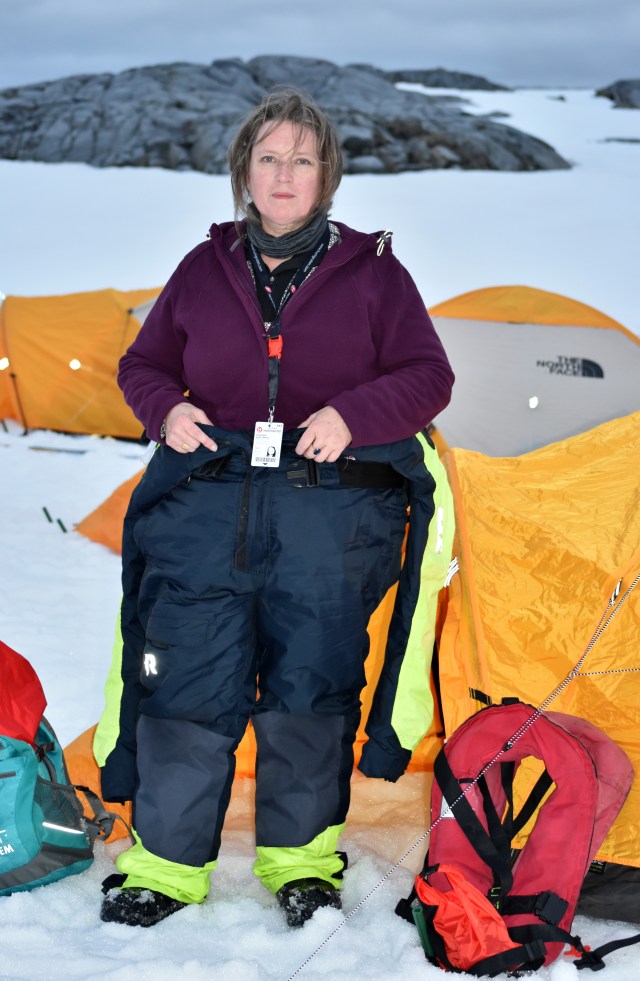
Another interesting discussion had to do with disengaging ourselves from our regatta suits. The suit was similar to the snowmobile suit I’d worn one January in Yellowstone. The regatta suit was a waterproof one-piece insulated pants and jacket. The jacket could be taken off and the attached pants would hang from my shoulders by suspenders. So all this would need to be dropped, together with the long woolen underwear, to expose our tender behinds to the risk of frostbite.
I told Anne I felt happy to visit this pole, and not the northern one, for now we only needed to worry about the odd penguin. At the northern pole we’d need to keep watch for polar bears. She told me she didn’t think penguins were birds of prey. I wondered what penguin tasted like. All the explorers wrote about eating them. Anne said they probably tasted like chicken.
Midnight showed us a sky completely different from anything I have ever seen. I’m no astronomer but still look up often enough to recognize the two Dippers and Orion’s Belt. I’ve seen the Milky Way now and then, too, and wherever I’ve been in the Northern Hemisphere the sky looks pretty much like itself.
But looking from here I felt far from home. The stars weren’t in the right place. The North Star was missing replaced by a strange group they call the Southern Cross. It didn’t look so much like a cross, more it seemed a diamond. The song by Crosby, Stills and Nash kept playing in my head and made a little familiar connection between me and that strange sky. But, still, they weren’t my stars.
What was mine was the Milky Way. I’d never seen it like this. But it was familiar. Although, the Milky Way I knew was more a deer trail through the sky compared to this six lane superhighway at rush hour. It lit up the night. Even the Magellanic Clouds, two dwarf galaxies orbiting the Milky Way, were easy to see.
It reminded me of why I had come, why I stood here, of exactly what those explorers from a hundred years ago saw when they looked up. Nothing had changed in the sky since then; except for the International Space Station, of course. But that was just another set of lights on this big road.
Anne had followed Robert Falcon Scott and I had come down here because of Ernest Shackleton. They all looked up at these stars, not just at their beauty, but for their survival. Shackleton could never imagine that someone like me would no longer need to use them for navigation; that someone like me would stand here warm and dry and well fed to look up only for the pleasure of it. He could never imagine someone standing here able to travel back home a week later without frostbite or discomfort. I felt spoiled, embarrassed, awed by attempting to compare our circumstances. If the wind hadn’t started pushing me along I could have stayed there most of the night memorizing what the sky looked like at the bottom of the world.
Snuggling down into my deliciously warm sleeping bag beside my sleeping tent-mate the walls continue a wild beat around me. I think about Ernest Shackleton out in that wind. I consider who he might have been, who the man, Ernest, actually was. What kind of man leads men through such hardship? He lived on open sea ice for two years in simple canvas tents, reindeer skin sleeping bags wet from melting ice, no way to bathe, dried peas, Pemmican and penguins. And all his men survived. They waited on a small strip of beach while Earnest and a few others sailed a small boat over three thousand miles across the wildest ocean on the planet, through storms that obscured navigation landmarks in the sky. Biologically he and I aren’t different. As Carl Sagan said, we’re both made of star-stuff. But, who was the man? I can’t begin to scratch his surface.
Ernest Shackleton, so much more than me, made of stuff I can’t even imagine.

Icebergs.

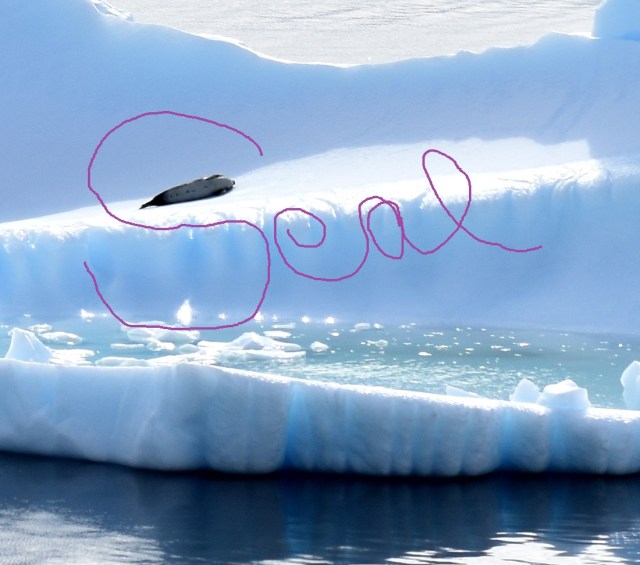
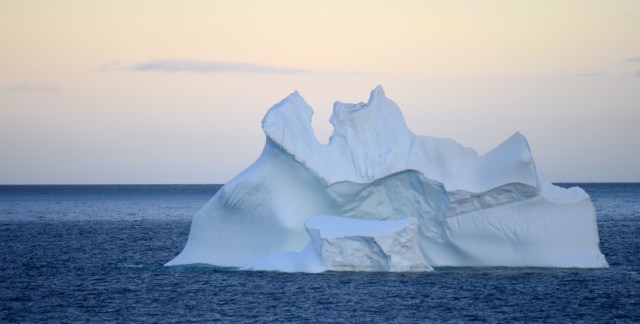
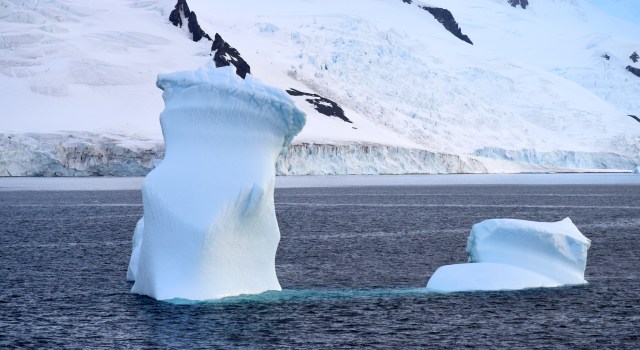
Icebergs are so varied. And of course I had a favorite. We sailed past it on several occasions in and out through the Lemaire Channel. This is by far the prettiest iceberg in the whole southern sea, it looks like a flower.

DSC_0285 copyHere it is from another perspective. Farther away. Still pretty.
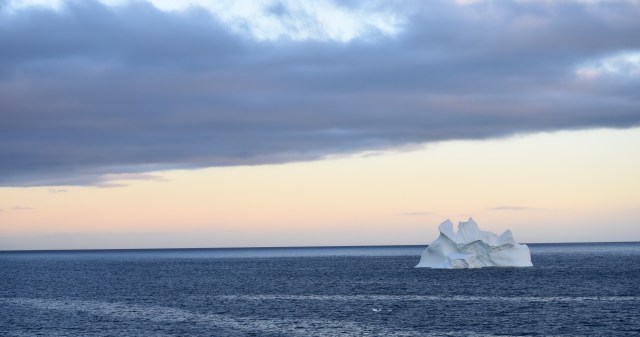
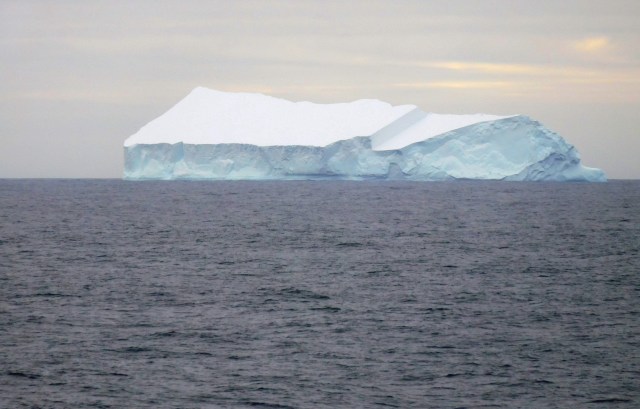
DSC_0283You know icebergs are only 9-10% visible. 90-91% floats below the surface.
DSC_0294 copy

I’d love to know what this one looks like beneat the water.

Berg 1

Antarctica has at its center a 1.7 km deep snow-ice cover that never melts… not much anyways.  (For the metrically challenged that’s about 2 miles deep.) I’m not going to discuss sublimation, how it’s so dry in Antarctica that snow-ice evaporates instead of melting. Anyone with a freezer that self-defrosts is aware of ice cubes only 1/2 expected size when returning home to a cold drink after a lengthy vacation.

Snow packs deeper and harder for centuries and becomes ice. At a glacier’s bottom you can have ice packed so dense there is no oxygen-air bubbles in it. That’s where you get that crystal clear blue ice… that I didn’t get to see a lot of.

As the glacier flows out towards the edge of land, where it meets real water, some bits break off, calve, and floats away on the ocean surface and sometimes runs into big ships in the night. Although, with all the sonar and satellite imagery today that would be pretty hard to do.

groundingline2da

Remember a few years ago that gigantic piece of ice that broke away from a frozen Antarctic sea and floated north? It was the size of Rhode Island. BIG. On the African side of the continent you see more of the BIG flat tabular (table-top-like) bergs.

antartica-5003

(This is not my photo… the internet gave me it.)

Glaciers wear away mountains. Look at the valley where there used to be rock.

DSC_0344

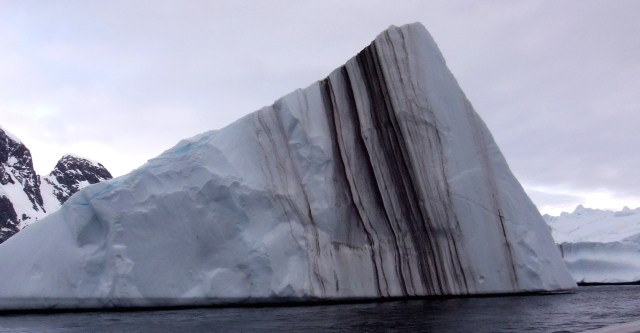
That missing rock has ended up bit by bit, season by season, like tree rings in the iceberg below. Sometimes water with silt flows over the top of the ice, to be buried in snow rings winter after winter. Sometimes the glacier picks up silt, stones, boulders as is slides over land.  I saw a giant rock stuck in the side of an iceberg. The glacier underneath may be so heavy and pressurized  that there might be an actual layer of water between the ice and its undersurface, usually rock.

In Illinois we’re pretty used to moraines, the pile of dirt and rock pushed ahead of a glacier and left behind as great ski-hills in our more civilized times. (Yes, there are a couple hills in the Midwest US…) Glaciers are an awesome force of nature, wearing away the mountains. Flowing water does the same. Think of the Grand Canyon. Glaciers are just water in another form.

DSCF5438

Also, some icebergs have surprises.

Iceberg 2Iceberg 3 (2)

Some have a lot of surprises.

DSCF5385 copy

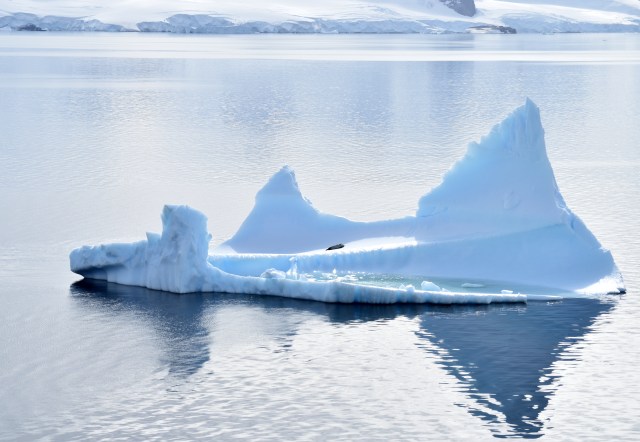
We were lucky. We saw quite diverse shaped ice formations, like all the following. And  I photographed  these myself.

And finally, a picture of Iceberg’s mother. This is a smallglacier off to the right.

fRAM bRANSFIELD sTRAIGHT

The Antarctic World: Inhuman beauty.

DSC_0334


Thinking about the title of this segment lead me to open my Thesaurus.  My first word choice was ‘brutal’, but it didn’t seem the right word. It worked, but seemed too harsh, too negative, maybe. When I looked up synonyms to the word brutal I met with: Ruthless. Cruel. Pitiless. Heartless.

DSC_0305

Maybe because of our human self-centeredness we feel that anything not friendly to us is against us.

Beautiful

But Antarctica isn’t any of those. It’s not concerned about emotions, revenge, or even survival. Antarctica isn’t harsh, Antarctica has a harsh environment, for humans. It isn’t concerned about anything human. In itself, Antarctica just…is.

DSC_0297

Maybe that is one of the reasons coming here is so strange, unexpected, interesting. There is nothing human about this continent. It is foreign to us. It seems to exclude us and the very thing we prize most, life. Animal life only exists along the edges and is extremely sparse. For example, of all the billions of insects in the world, only one insect species is known to live here.

DSC_0331

DSC_0352

Everything human has to be packed in and secured by deep stakes… or it simply blows away. I remember reading in one of the books written by an early explorer about a 300 pound steel lid that landed almost on top of him after flew 50 meters. Wind.

DSCF5356 copy

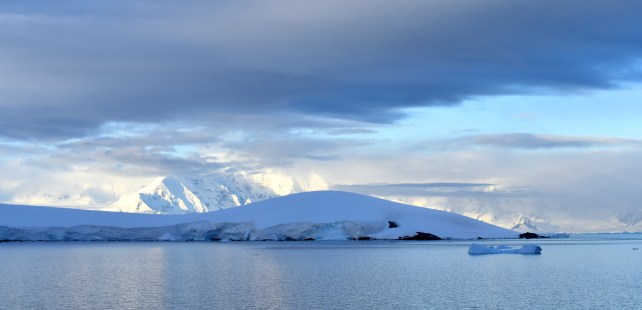
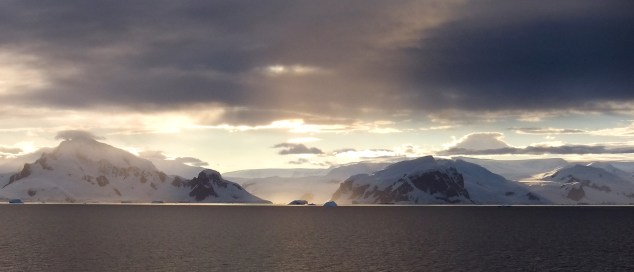
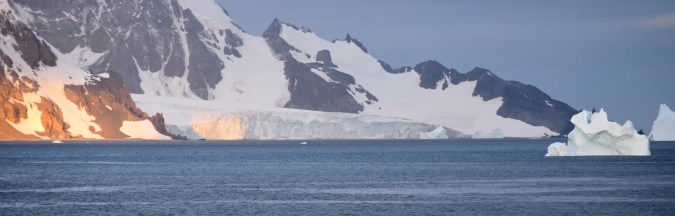
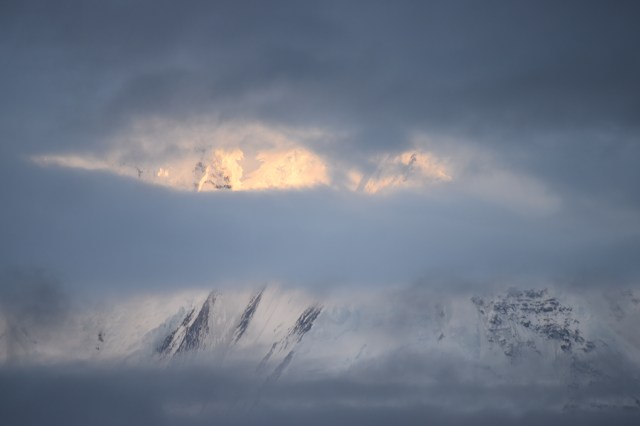
But beauty abounds, stark cold blue and white and black beauty. Although if you’re lucky enough to see sunrise or sunset the colors can be so complex and varied, warm, extraordinary, surprising, astounding… pretty.

DSCF5345 copy

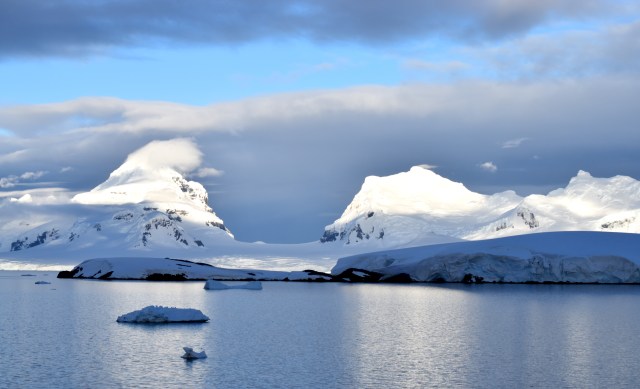
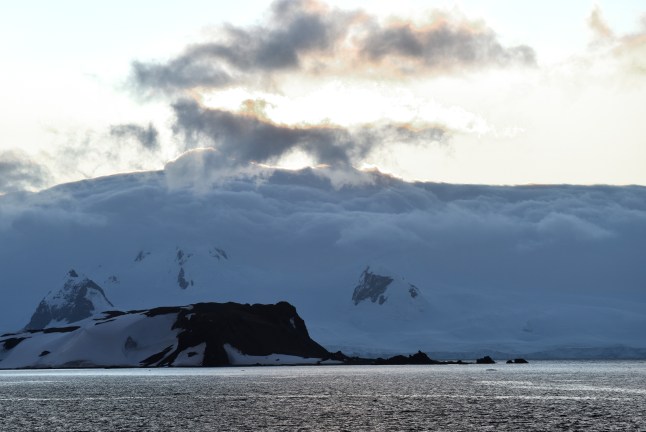
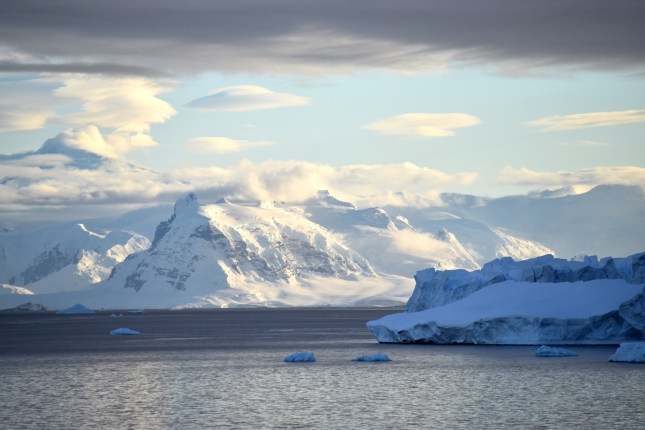
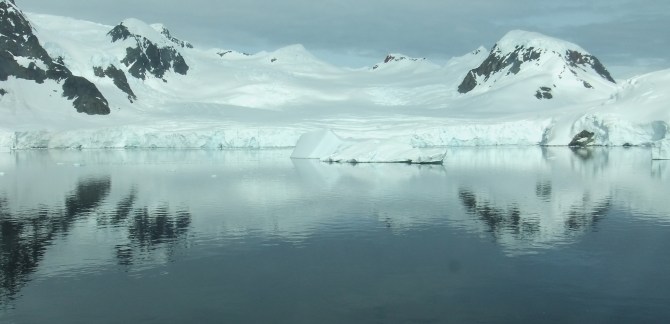
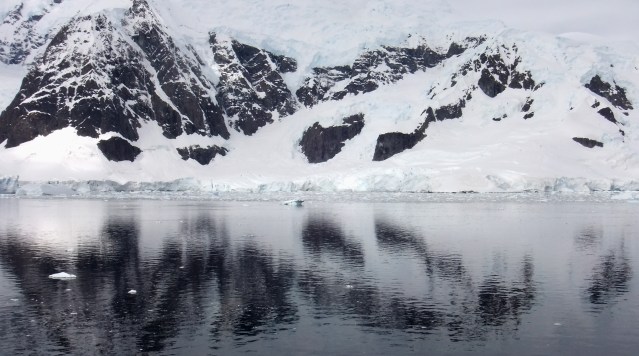
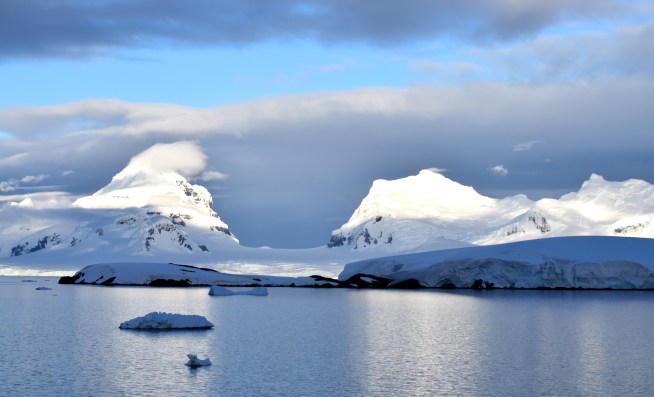
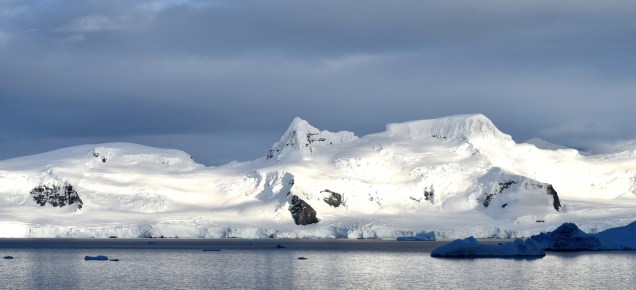
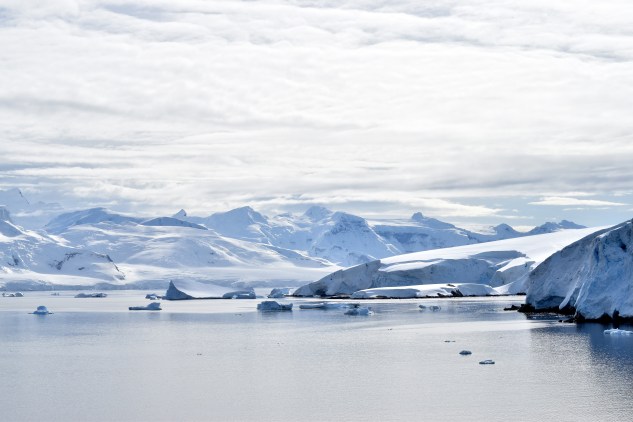
These pictures are from the Bransfield Straight, Gerlache Straight, Lamaire Channel and Paradise Harbour. You can also see how lucky we were with the mirror calm sea.

DSC_0344 DSC_0337 copy DSC_0493 (2)

The End. (Of the world.)

DSC_0267

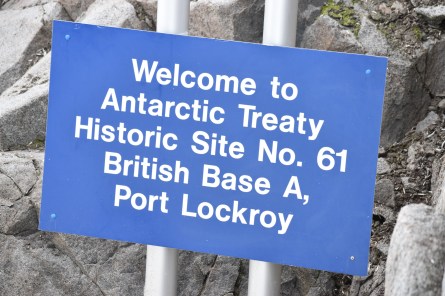
Port Lockroy, Antarctica: Research station, penguin post office and gift shop.

DSC_0129

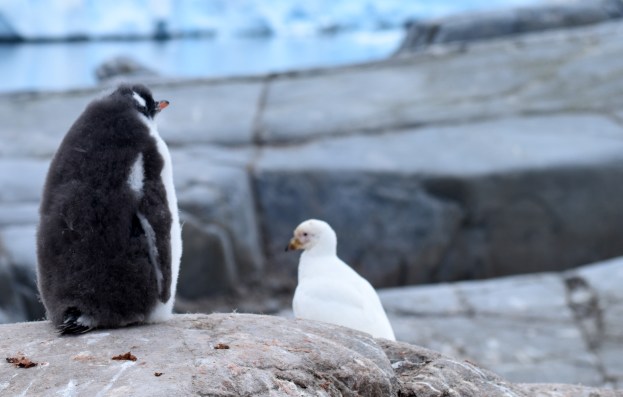
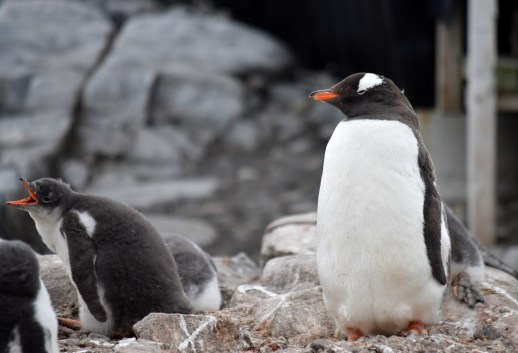
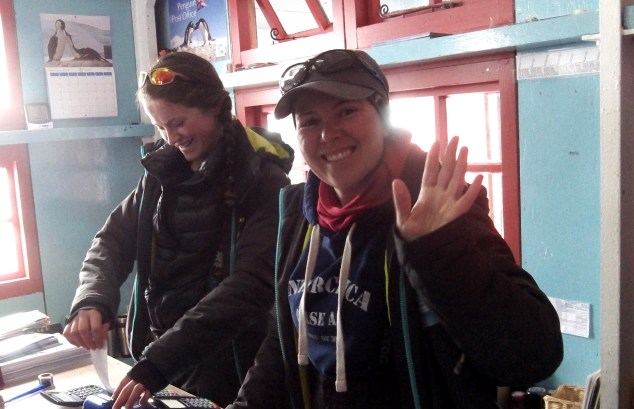
Port Lockroy, Antarctic Peninsula, is a cute little station on a tiny island filled with Gentoo penguins, Snowy Sheathbills, and girls who work selling t-shirts and post cards in the gift shop.

DSC_0235 copy copy

Port Lockroy, Antarctic Peninsula, Neumayer Channel.

They only man, or woman, the station during the Southern Hemisphere summer. Which occurs during winter for us nothernists. Can you be a hemisphere bigot? My Australian friends must have an answer to that…

In any case, it’s set in a very pretty location, on a little island , a glacier across the way.
Port Lockroy was set up by some Brits wanting to maintain their frostbitten toehold on their Antarctic ‘posession’. They had the brilliant idea to set up a secret base to watch the Nazis. I never really figure out how that would win WWII, and suspect it was either an excuse to avoid the London Blitz or some young forward thinking scientist’s opportunity to study Antarctic wildlife. Which they did for a while, and later new scientists did atmospheric studies.

100_1913
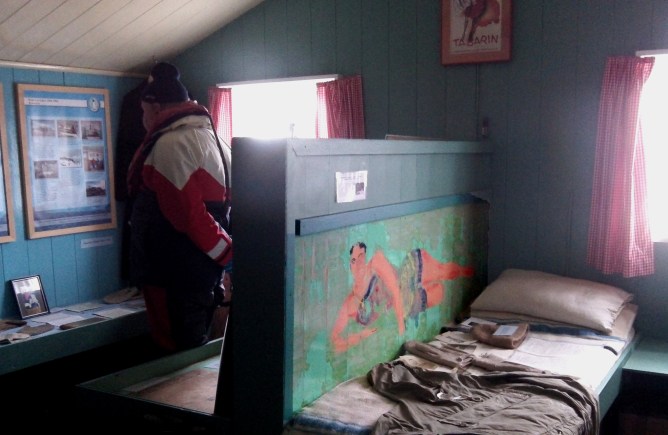
They  now are a kind of museum and have all the old rooms set up looking neat and pretty like they did 60 years ago. All the old instruments and spare furniture are there, old cans and boxes of food on the shelves. The old gramophone the guys used for entertainment still works.
Like many bases, this one was left to fade slowly into cold decay, until a group of people decided to save and restore the old explorers huts including several old bases, and even the entire island of South Georgia. The Antarctic Heritage Trust is based in New Zealand and raises money for preservation of such places as Shackleton’s old hut.

Actually, in Shackleton’s old hut they found a few cases of frozen Mackinlay’s scotch that was analyzed and reverse engineered and is now sold with some of the profits going back to the Trust. I’m saving up for a bottle, it runs about $150 in the US.
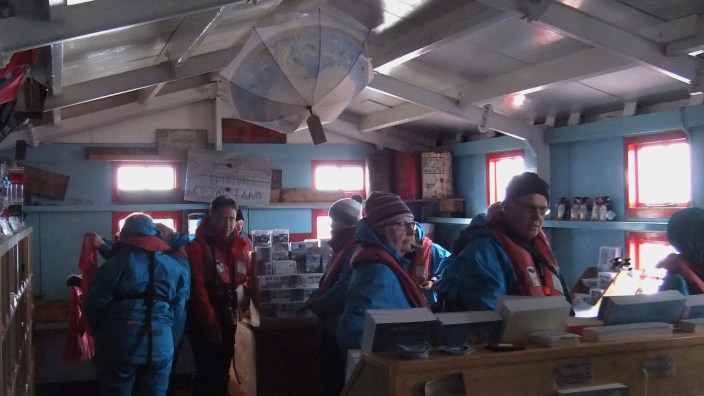
These days this base receives visitors, cruise ships like MS Fram, and sometimes even private sailboats. Enough visitors  come to see the Gentoo penguins they maintain the gift shop, where they sell… gifts. T-shirts, bookmarks, books about the area and its history, and jewelry etc.

Gift Shop

Looking at the photo of their store I realize I should have bought that umbrella with Antarctica on it… . I also missed out on a very nice t-shirt with penguins marching across the back.
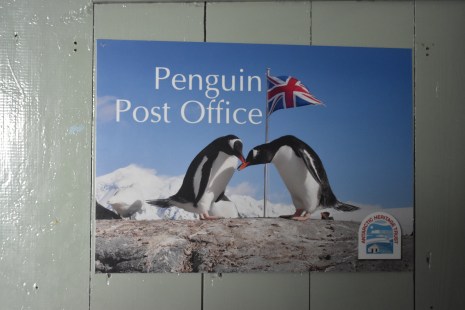
They also have a Penguin Post Office.

DSC_0148

This is the  post office of Antarctica. According to the British… (I suspect the Norwegians and Americans, at least would dispute this. Although I heard this is the best gift shop on the continent…) So we bought post cards, wrote them, bought pretty local stamps, and mailed the cards in their mail box. Then the women who work there,100_1880

after they had showered on board our ship and received some fresh fruits etc, bundled up the mail and it was taken aboard our ship. To be posted in the Falklands, I think. The cards I mailed from Port Lockroy arrived in Norway, the UK and Chicago all on the same day, two weeks after I came home… 4 1/2 weeks after they were mailed.

Penguins aren’t carrier pigeons.

The retired Carrier Penguin.

The nearly extinct Carrier Penguin hard at work delivering my cards.

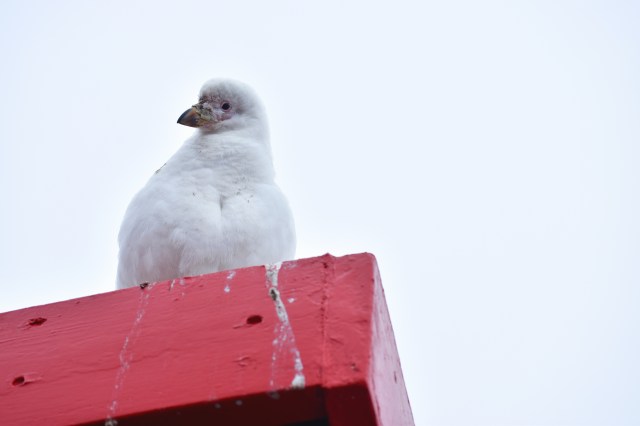
Gentoo penguin chicks and Snowy Sheathbills as well as some other birds I welcome you to look up on the internet, breed there. The lurking Snowy SheathbillWaiting for mom.

is a pretty white bird with a very ugly face. It makes its living jumping on baby penguins to interrupt feedings as the parent regurgitates food into the baby’s mouth. When food spills, the baby can’t eat it up, it only eats from the parent. The parent doesn’t pick up the food, it only eats from the sea. So that food is wasted and eventually eaten up from the ground by the Sheathbill and other scavengers who don’t mind stealing baby-food from penguin chicks. My only comment is this… I couldn’t tell the difference between spilled food and penguin poop. I hope the Sheathbill can.
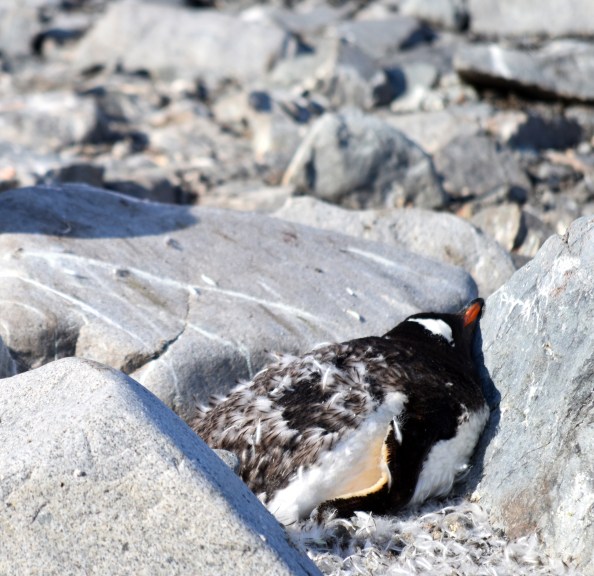
Many of the penguins were molting.

Molting Gentoo Moulting Gentoo

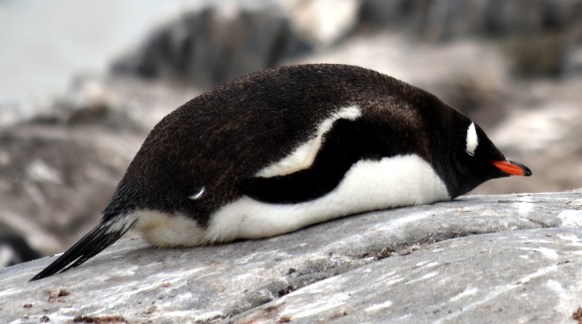
Sleeping, not dead.

They suddenly lose all their feathers over 10-14 days as the new ones simultaneously grow out. It’s pretty stressful for the birds and takes a lot of energy to suddenly grow an entirely new crop of feathers all at once and that fast. They seem to stand still for 12 days as it happens. They can’t go in the water because they no longer have their water and cold proof insulation until the new feathers are all in place. They can’t eat until it’s done and it’s a pretty vulnerable time for the bird. Tourists are told to give them wide berth; fortunately they seem to ignore us.
Gentoo and chick.Done molting.

A group of people were able to take a kayaking tour around the pretty ice speckled water, not me. I was a bit afraid of killer whales… I didn’t want to be the first kayaker eaten up in the Antarctic. Although by the time we reached South Georgia I’d regretted my cowardice and not kayaking past the icebergs so much I kayaked there amongst the seals and King penguins. Where there are seals there are killer whales, right? Sadly, I never saw one, so won’t be making a watercolor of one of them, either.

As I left the gift shop I looked up and along the edge of the roof sat a dozen Sheathbills looking down waiting for us to leave them to their thieving ways. I had a photo of line of them along the roof edge but this picture will have to do until I find it.

Snowy Sheathbill lurking.

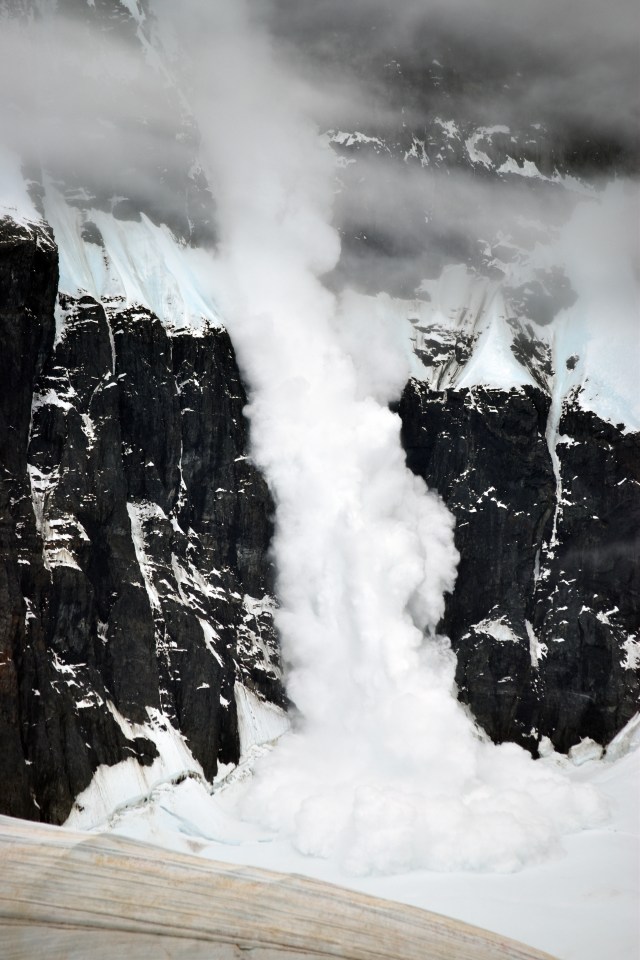
As I looked around and considered walking back to the dock I heard a low growling rumble, and looking around the corner of the building to see an avalanche.Avelanche

So I did get to photograph my first avalanche! If I’d stood any closer I wouldn’t have had to worry about killer whales. That is almost true. It fell, not on the island,  but off the mountain on the mainland a thin watery channel away. As you can maybe see I used a 200 mm lens so… close enough. Wish I’d filmed a movie of it, but then I couldn’t share it with you.

After this I walked back towards the boats. And this little guy started down the path after me, so I stopped and waited for it to walk close and snapped this picture.

DSC_0203

You have to stay 5 meters away from them. (I think it’s seals that are 15 meters, but cant recall exactly.) But when they walk up to you, it’s ok. So I waited for it to get close… until I looked up.

DSC_0205 (2)

All my MS Fram friends weren’t allowed to walk down the only path towards the penguin and her posing for me was holding up the whole show.

Poisoning

That gift shop was the cutest little shop… and I regret not getting that umbrella, and there was a t-shirt with a row of penguins on the back… I’ll have to go back… As you can see by this picture I’m just getting over four days of food poisoning after that packed lunch in Tierra del Fuego. Antibiotics are my friend.

Mist, and other musings.

Mist, or the thing that keeps you from seeing anything farther away than your hand, and a few random musings.

DSC_0272
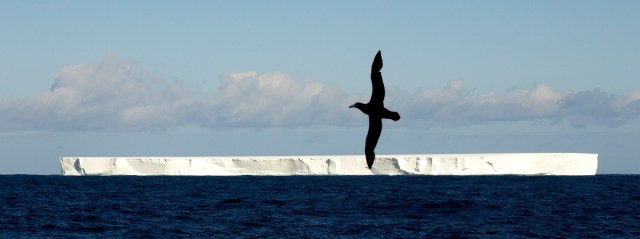
You’re sitting in the lounge looking out at the horizon through the floor to ceiling wall to wall windows. Or maybe you’re just looking at that weird-winged bird that probably isn’t an albatross. And then you make a mistake. You innocently take a sip of your tea. And when you look up again, the bird, the horizon, and even half the ship is gone.
Gray-white mist as far as you can… well, can’t, see. And it seems to happen in an instant. I don’t know where it comes from. Maybe the ocean just then is a bit warmer or the air is a bit colder, or maybe a cloud expanded vertically. So you strain your eyes a while and after another sip or two the horizon reappears and you can see whales or birds to your hearts content. Provided the wildlife cooperates, of course, which they usually don’t.
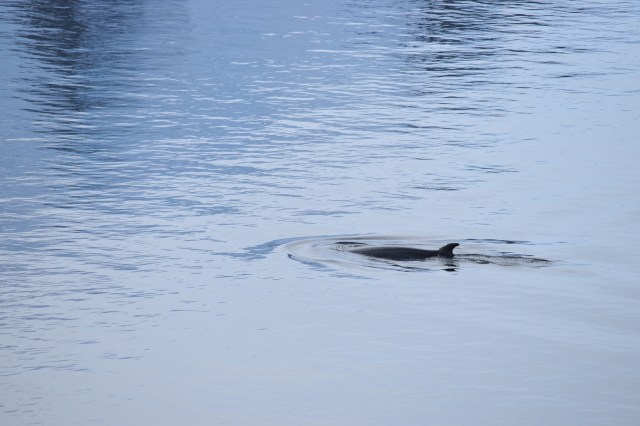
One of the passengers I’ve seen taking photos, a sweet young woman from Hong Kong, came in yesterday with an awesome photograph of the tail flukes of a humpback whale. I missed it, probably while refilling my cup. All I have to show for my whale watching is a tiny dorsal fin that might belong to a Minke whale. The jury is still out, as the photo looks a bit… foggy.

DSC_0490

She chose the humpback photograph to paint in our watercolor class. During our at-sea days, for example the two days spent travelling from the Antarctic Peninsula to South Georgia, our resident photographer has been showing us how to paint watercolors of our best photographs. I chose a Gentoo penguin which ended up looking like Donald Duck,

and later, I tried painting the misty rocks at the opening into Deception Island’s harbor. That worked out a little better as a guy actually recognized that I’d painted rocks.


The sea is strange. We’re moving across it at the unusually fast speed of 13-14 knots because the weather is so good and there are almost no big waves impeding our forward progress. But then every once in a while there will be a few minutes of swells that stagger you from one side of the hallway to the other as you walk drunkenly towards your room. Then a few minutes later all is well and you can pass a sobriety test. Where these rollers come from, and why they travel in a little grouping and then vanish, I have no clue.
Another strange thing, we have seen no other ships for over a week. We have seen no airplanes, not even a contrail, since leaving Ushuaia, Argentina on the first day of the cruise. We’re travelling around with our own little society of 237 passengers and a few more as crew.
We’ve met a few people, though. Two of the stations we visited in Antarctica were manned, or womaned. One was an Argentinian research station, Base Brown, in Paradise Harbour, a gorgeous place of blue skies, black mountains spotted with pristine glaciers and misty crowns that reflected in dark blue water speckled with strangely shaped blocks of ice.
One fun thing here was watching and actually photographing an avalanche across from the station. Too bad I didn’t think of filming it…

Avelanche

Our crew brought the researchers a box of greens and fresh fruit as thanks for allowing us to look at their Gentoo penguins and seals. The tourist ships that stop by on a regular basis bring or take away mail, supplies and break the monotony of the isolated researchers.
At Port Lockeroy, a British research station, a few women operated a little museum and gift shop and the “farthest south” post office where you could mail post cards from Antarctica.

Of course, our ship is still carrying that sack of mail and it will arrive at the mainland when we do. Those researchers were “paid” by our staff by being allowed to shower onboard the ship. The proceeds from their gift shop go towards maintaining the base and their research, as the UK is supposedly stingy with their grants. They study two groups of Gentoo penguins, one allowed contact with humans versus the other group on the other side of the base that are not allowed contact with humans. I saw no fence…

DSC_0427 copy
Well, I’m off to bed. Tomorrow will come fast since wakeup time is 5 AM when the sun rises. Our speed has been tweaked so we arrive at the south-eastern edge of South Georgia exactly at sunrise so we can spend the 3-4 hours sailing towards Grytviken watching for birds and whales in a krill-rich area.
I really hope the mist clears. I don’t want to be the only one without a watercolor of humpback flukes.

Home Again

The sea landing on Antarctica this morning would be easy. I could tell because my bed rocked with only the subtle irregular movement of calm seas. And Tessa’s melodious, “Good morning ladies and gentlemen…” from the speakers of the television above my bunk woke me as usual. Her voice came early this morning, as it often did when the morning weather was good but threatened more wind and more waves later in the day.

The fact that I was home in my bed in Chicago didn’t seem to blunt the experience. I’d gone through this so many times over the last 3 ½ weeks it was all deeply familiar.
Tessa

Tessa always told us where we were by the location name, latitude and longitude, temperature, wind speed, barometric pressure and future weather predictions, and what we might encounter good and bad on shore. (And even if there might be cookies, more about that later.) She was the Expedition leader, from the Netherlands, with easy command of English and German, and was maybe as old as thirty years. Hard to tell. She paid attention to everything and everyone and never minced words. I’d hire her to run anything.

The evening before landings she would brief us on what to expect the next day. Always these plans were followed by: “…if the weather allows.” Or, “…depending on the conditions on shore.” The expedition team was always the first to land. They would evaluate the sea crossing, the landing site, maybe choosing an alternative site, and the situation on land with the animals etc.

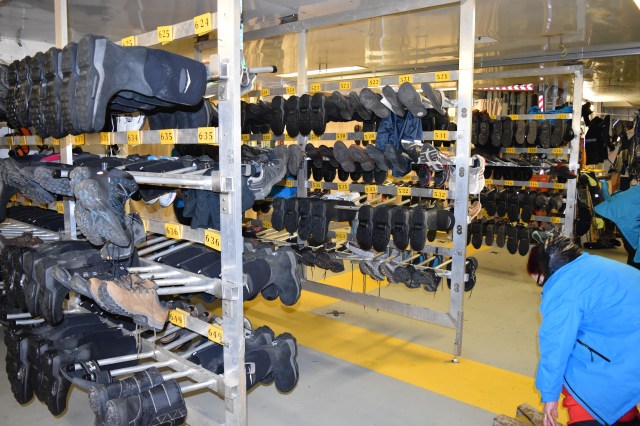
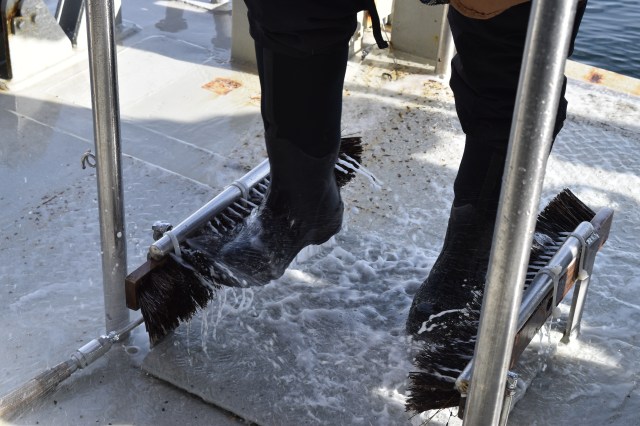
The only landing we didn’t make was Neco Harbour, Antarctica mainland. And that didn’t so much matter as we landed at an alternative site, just as interesting. Neco Harbour was cancelled because a number of dead penguins had been found and the reason for that was unclear. They did not want us picking up what might be a disease of some kind and spreading it to other colonies on future landings. Even though we had been loaned well-fitting rubber boots that gripped even slippery rocks, boots we scrubbed in a contraption on entering the ship.

DSC_0459

Then we had to walk through a giant sponge soaked in disinfectant.

DSC_0457

And occasionally one of us would be singled out for special hosing down of our dirty boots or dirty waterproof pants (usually a thin water and wind proof shell worn outside warm pants) that we were all required to wear. If you knelt down, or as our photographers sometimes did, or lay flat on your belly in penguin poop to get a good shot, you’d get hosed.

DSC_0466

But about Tessa. One time I wasn’t sure I would get enough time to explore Port Stanley, the capital of the Falklands if I went on the sheep farm tour. She told me I’d be back by such-and-such time and might have two hours with stores and museum open, and if that wasn’t enough for me, I’d have to make that decision on my own. “You have to decide what’s your priority and that’s it.”

Sometimes the landings might be a bit rough, either the beach might be steep with round sliding rocks or the landing itself might be into a sea swelling with waves a step or two before dry beach, or the waves might toss the nine passenger boat around a bit as we stepped out onto the landing spot.

Or, the sea between the ship and the beach might be choppy and the landing boat might slap (and I mean… popping smacking pounding slaps…) the waves too much as it sped towards the beach, and Tessa would warn: “Be aware, ladies and gentlemen, if you have problems with your back or your hips this landing may be too rough for you. You will have to determine that for yourself.” Don’t come to her to complain if you felt slapped to a pulp and needed a chiropractor on a landing she’d warned you about. Or if you chose to walk the 4 kilometers (2.5 miles) each way across scree (lots of loose rocks on a sloping hill) to see the baby albatrosses, and when you returned to the ship couldn’t manage the walk to dinner.

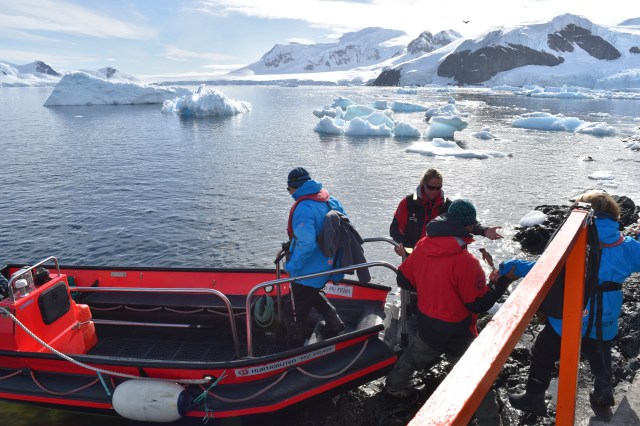
I do need to add that the PolarCircle boats were designed beautifully. They were easy to enter from the ship either from their front or from the side, and they were as easy to exit as could be managed. The hand holds and supports of the boat made transit very manageable. In calm water it was like walking two steps. In seas, we needed the assistance of one or sometimes two expedition members who grabbed us by the arm and steadied us until we stood on terra firma. I never felt anxious or unsteady.

DSC_0450

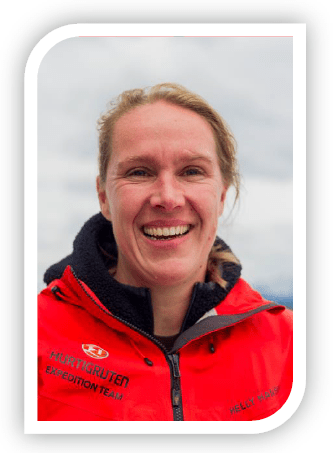
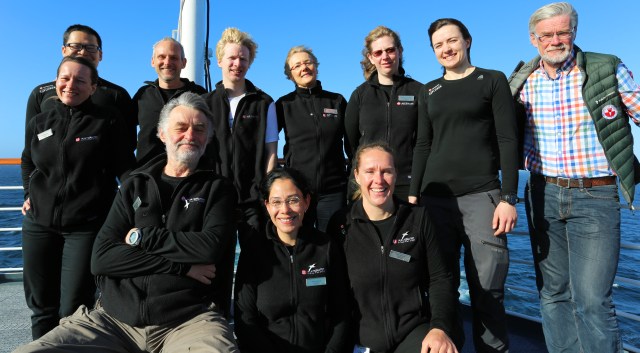
The Expedition team members were our guides, teachers, and eventually, friends. They lectured us once or three times a day on everything or anything relevant to our journey. They had an incredibly varied experience, ages (20-60) and nationalities (Norwegian, German, Australian, Chinese, Argentinian, and more).

FRAM_EL_TEAM_MARCH2016

They were always available on the ship for conversations and questions. And on excursions they either walked along with people hiking or they had posts along the way both for our safety and for questions, and for the safety of the animals and preservation of the environment. They are all certified by IAATO (International Association of Antarctic Tour Operators), and as tourists we also were instructed in the rules we needed to comply with to visit Antarctica. http://iaato.org/visitor-guidelines

Anyways, this morning I still awoke with what Erasmus Darwin, Charles Darwin’s grandfather, described in 1796 as ‘Mal de debarquement’ or sickness of Disembarkation. The only serious symptom seems to be nostalgic longing for my former days at sea, and for the wonderful expedition team who stayed at our side and guided us through the ‘experience of a lifetime’.

The last time I saw them was the morning we all left the ship. About 9 am the big doors on the side of the ship on Deck 3 opened and we walked out onto the pier in Buenos Aires like walking out through the door of a downtown building. At the door stood one of the expedition team to say goodbye. I didn’t think much about it.

Just outside the ship we entered the bus as it would take us on the two minute ride to the terminal building were our suitcases and customs waited. Two others from the expedition team handed us up the easy step onto the buses and said their goodbyes. It was unnecessary, but nice.

When we arrived at the terminal and exited the bus there was a holdup, and as we slowly stepped off the bus an expedition member shook each of our hands in farewell. It was such a nice friendly gesture.

Then walking inside the big warehouse of a terminal building and seeing all our 237 suitcases waiting, sitting on a low wall in a row like the snowy sheathbills sat along the edge of the roof at Port Lockeroy, all grinning and waving at us, were four more members of the expedition team. And then I finally understood. They had this all planned as a guided exit, a farewell in the same manner as any of our previous expeditions where they had stood along our route to guide us on the right path and keep us safe along the way.

As a writer I understood they were showing us the way, showing us out and back into our normal world, not with words but with their actions. By the time I stepped outside with my suitcase and looked for the taxi to the hotel, and met Tessa, our expedition leader, I had to fight to keep tears out of my eyes. They were paid to work as our guides, but they had become much more to us, they had become friends.

And I will miss them.


Antarctic camping

Photo by Winfrid

I won the lottery to go camping on the Antarctic mainland. Out of the 3 people who wanted to go… Ok, I’m joking. Out of approximately 50 people, 18 were selected to go.
We had to dress up in a nicely warm regatta suit, we were loaned North Face tents, the little yellow ones they use on Everest and in all those post-apocalyptic movies. We were loaned down sleeping bags rated to be comfortable at -20 F, and were given a bottle of water and an energy bar sanctioned by whatever Antarctic treaty sanctions such things. Trust me, everything here to the smallest detail has to be approved by some international committee.
Every day here has been incredibly unusual and beautiful. Apparently the weather rarely cooperates to this extent. The day I left for the ship I met some tourists who had just disembarked another company’s ship after the same cruise I’m on now. They had nothing but wind and storms, so much so they weren’t able to reach land at South Georgia or The Falklands. This is the exact opposite of my experience.
Back to camping. Our exploration leaders had chosen a beautiful and protected little camp site some distance from the ship. We layered on the clothing and boots and were issued our gear. Then we piled into the little boats and were off.

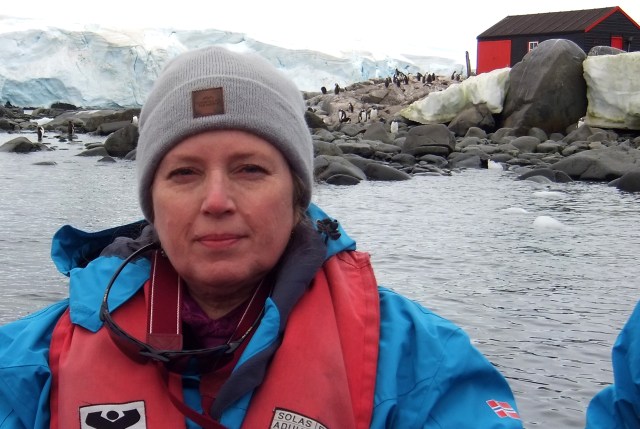
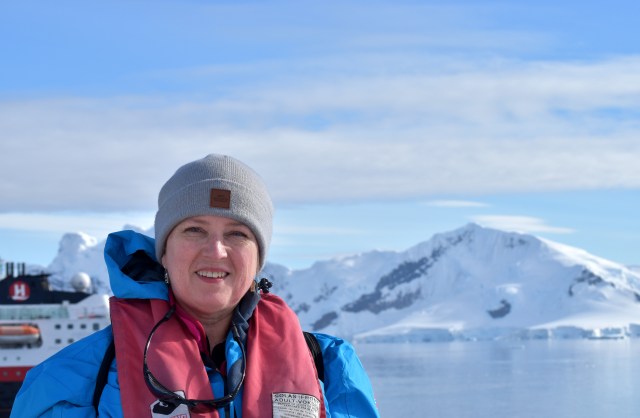
Me as polar explorer roughing it in Antarctica.  DSC_0003 copy

At the camp site we set up our tents. Then we complained about the clouds, and that no Milky Way or Southern Cross would be visible. After that we milled about trying to ‘feel the experience’. I decided to sit down on a rock and write a bit in my journal.

DSC_0014Our little tent city on Hovgaard Island close to Lamere Channel and Booth Island.The red jacket is our expedition team guide.DSC_0025Our tent at night all shored up with snow to keep the loose parts from flapping too loudly at night. Of course, as you see below, the wind was so strong no amount of trenching up the gaps made any difference. The wind blew, the tents flapped, and my earplugs came in very handy.DSC_0018
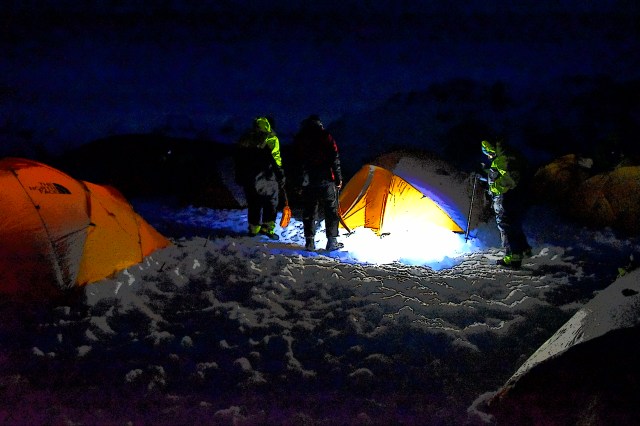
 

After a while the wind picked up a little, then if kicked up a bit more, and then a bit more and I was suddenly holding on to the pages of my journal unable to write for the whipping of the pages. This entire episode took no more than 2 minutes, from sitting there with barely a breeze to packing up my pen, 2 minutes. It blew hard all night. So much for the silence of the Antarctic, the wind howled and whipped and slapped the tent flaps about so much I could roll around restlessly in my sleeping bag and the lovely woman from Devonshire who shared my tent couldn’t hear me move.

The next morning the two room mates, Anne and Ann.

I have to admit I slept pretty well, insulated in that awesome bag where you could sleep in your undies and stay wonderfully cozy, unless you had to use the necessary room. This was a little portable potty outside, 50 yards away, behind a rock. ‘Freezing your butt off’ was no longer a cliché.
By morning, sunrise was at 6 am and that was our que to pack up and return to the ship. We waited to be picked up by the little skiffs and made friends with our neighbors.

The experience was another one of those that knocks you out of your everyday life. Something unusual, memorable, and utterly useful for an aspiring writer.Our neighbor.jpg

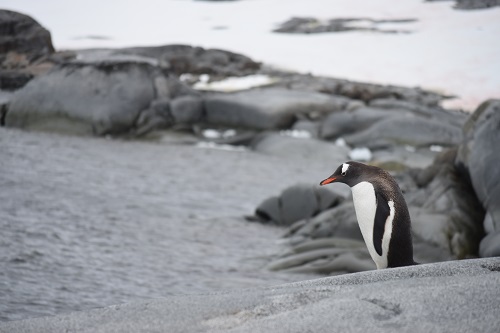
Our neighbor a Gentoo Penguin.

What I did on my summer vacation

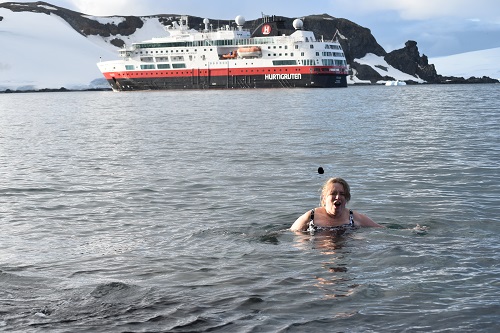
What I did on my summer vacation, or… swimming in the Antarctic Ocean.

When our expedition leader told us the doctor would be on the beach standing by, we understood somebody was taking this swimming thing too seriously. Hurtigruten offers swimming opportunities every Antarctic cruise, and usually about thirty Norwegians, for the most part, go for a swim in the 2 C (35 F) water. They keep reminding us that medical rescue is a 36 hour affair, so “don’t get hurt, don’t get appendicitis”.
We were instructed to dress in our bathing suits under our layers of thermals, fleece and woolens, as the penguins hadn’t provided a changing hut. In my case, just on my legs I wore long thermal liners under long thin woolen pants and Gore-Tex wind and waterproof storm pants over it all. On top, two layers of woolen undershirts, a fleece jacket then the light blue storm jacket Hurtigruten gave us the day we arrived. We also, of course, wore liner gloves and waterproof shell mittens, and liner socks then wool socks and rubber muck boots. And a wool hat, maybe under a hood or two. All this would need to be removed before swimming. And put back on afterwards.
(Full disclaimer here, the weather has been disconcertingly great, sunny and in the 30’s F, think global warming. So the massive dressing is mostly needed for the trips across the water in the rubber boats.)
When asked what the swimming situation would be, we were told there would be, in addition to the doctor, towels. But it seemed the doctor was only there to take our names before we ran into the water and to hand us a towel when we ran back out.
The opportunity was, of course, irresistible. Who wouldn’t want to go home bragging about swimming in Antarctica? They even told us they would give us an official certificate as proof. I love certificates.
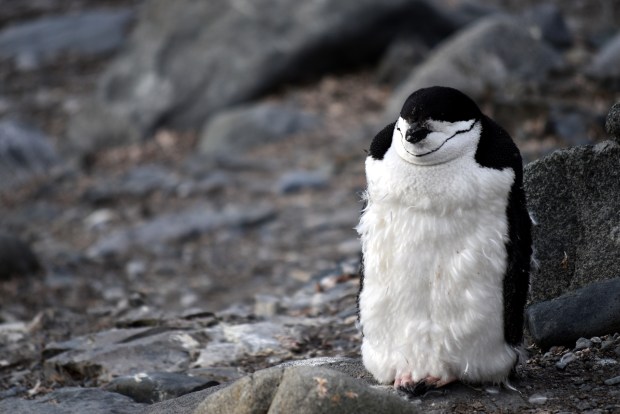
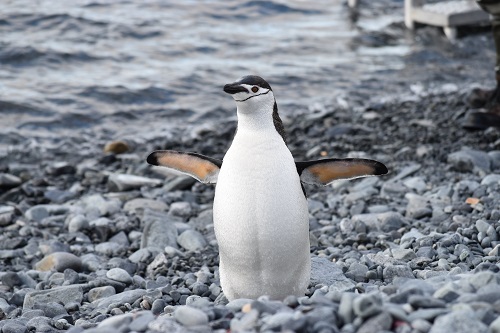
So, I did it, after about an hour walking around photographing chinstrap penguins and fur seals, trying to build up courage. I wasn’t afraid of freezing to death. I’d be offered a towel, right? But the pain of it…
The most useful suggestion they had was to do it quickly and don’t think too much about it. Good advice. The water felt, as expected, like frozen knives slicing off your skin. But the bad part they didn’t mention was the sloping beach made up of 3-5 inch rounded ‘river’ stones that slid around and provided poor purchase for semi-frostbitten feet and you always felt off balance.
I didn’t stay in too long. Someone snapped about 10 pictures of me, but every one of the pictures captures my face in an unattractive silent scream.

When I came out of the water the 35 F air felt positively warm. And the following day my certificate proof of Antarctic swimming (loosely defined in my case) was posted on the door of the cabin.
I’m proud of myself, not for jumping in the water like all the other dumb people, but for pushing myself into doing something extremely unpleasant, something unusual, and something that marks that day as an entirely different kind of day in my life. Without events that rise above the ordinary, what is there to remember?
My mother’s words come back to me: If everyone jumped off a cliff would you? Obviously… yes.Antarctic swimming..jpgAntarctic beach with Chinstrap Penguin.jpg